This gingerbread went down well with family avoiding dairy and eggs due to a food intolerance. Caryn has shared this Nigella Lawson recipe with a number of friends who all had a go and enjoyed the results. Works well as a cake and would also make a great pudding.
Red lentil and tomato sauce

As you can see from the cover of ‘The Bean Book’ by Rose Elliot, it is a well used book with many delicious recipes. Caryn often makes this red lentil and tomato sauce as it goes well with mashed potato or pasta.
Group update 7th December
Here is our latest group update.
If you would like to sign up to receive group updates, then please complete our mailing list form.
Christmas decorations and presents
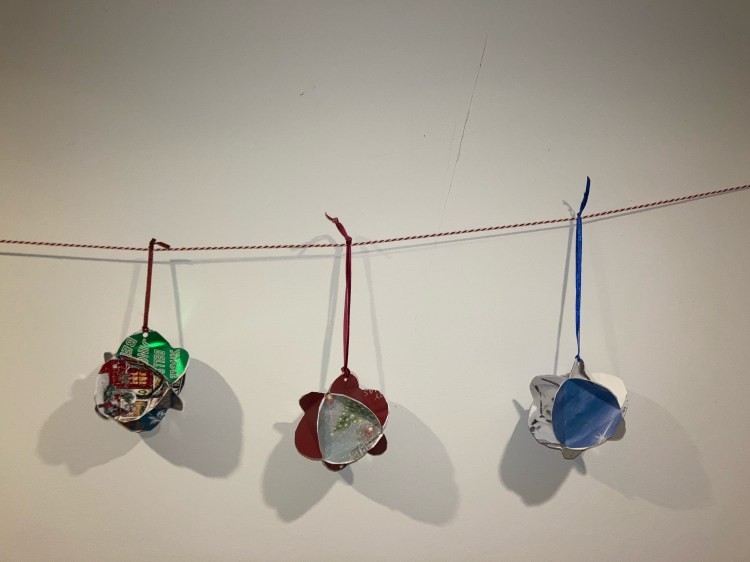
Here are some ideas gathered together, on a Pinterest board, for Christmas decorations that can be made by recycling waste.

Kate has had a go at making the ‘gingerbread’ decorations and Christmas card baubles. She has also made the gnomes from old jumpers and scrap fabric stuffed with filling from old pillows.
Broccoli stalk soup (serves 2-4)
One of Caroline’s favourite soups
Ingredients:
3 large broccoli heads with stalks and florets separated
1 small leek chopped (use all of it)
1 litre vegetable stock (eg marigold or kallo)
extra virgin oil
pinch of smoked paprika
large handful of leafy greens (eg spinach or kale)
1 tsp grated ginger
200 mls plant milk
Garnish:
spring onion green tops and leftover peas
Method:
- Cut the broccoli stalks and florets into 5 cm pieces.
- Bring a saucepan of water to the boil then drop in the broccoli stems, florets and leek.
- Simmer for 3-5 minutes.
- Remove the veg from the water but keep the water to add to the stock (which preserves the nutrients).
- Make up the stock water to one litre and add the stock powder/cube and simmer for 5 minutes.
- Put cooked broccoli and leek in a blender with a splash of olive oil, salt, pepper and paprika.
- Add the warm veg stock, leafy greens and ginger, blend until smooth and creamy.
- Slowly add the milk on a low speed.
- Serve topped with spring onion tops and leftover peas, and wholemeal bread.
Planting and keeping trees event
The theme for our online monthly meeting, on Tuesday 15th December starting at 7.30pm, is planting trees.
There will be a variety of short presentations including tree planting in Stokesley, Hutton Rudby and Ingleby Greenhow and input from a local resident who is lucky enough to be planting his own wood and another who has developed a forest garden. There will be information about funding for planting trees and a discussion about finding suitable land, which trees might be appropriate to plant and managing the planting afterwards.
Finally, as a reminder why we should look after the trees we have we will look at the ongoing Ancient Tree Inventory, an initiative which records the ancient and old trees across the country. Some very local trees will be used as examples.
The meeting link will be sent out in our next update. If you are not on our mailing list then contact us for the link or sign up to our mailing list.
Group update 12th November
Here is our latest group update.
If you would like to sign up to receive group updates, then please complete our mailing list form.
Group update 6th October
Our latest group update including a final reminder to ask you to sign our letter, if you haven’t already done, to show our MP that a lot of his constituents are asking for a green recovery plan from the coronavirus pandemic.
If you would like to sign up to receive group updates, then please complete our mailing list form.
‘How bad are bananas?’
‘How bad are bananas?‘ – by Mike Berners-Lee – – new edition – updated and expanded – 2020 Profile Books.
“I suspect as you are reading this review, you would like to do the right thing for the climate or at least wanted to be armed with the facts so you know how to really reduce your carbon footprint, then this is definitely the book for you.
Firstly, this book is about understanding “the carbon footprint of everything”, so it is not about saving the rain forests or stopping using plastic or increasing biodiversity or reducing waste or being vegan, unless the numbers prove that by doing these things they will reduce your carbon footprint. So by reading the book you will learn that stopping using plastics or even reducing your waste or even increasing biodiversity are not necessary, but stopping burning the rain forests and becoming vegan will definitely reduce your carbon footprint. Obviously, there are other good reasons why you would want to stop using plastics, reduce waste and increase biodiversity. These were some of the areas that climate deniers have tried to use to change the conversation and distract from the existential threat to the planet of ever increasing carbon dioxide levels in the atmosphere.
What’s it all about, the approach is to lay all the facts in front of you about the amount of carbon dioxide that is generated by everyday actions whether it is eating a banana or crashing a car, allowing you to understand how to make better decisions to really cut your carbon footprint.
Bananas are in fact good, as they have a high nutritional value and as they grow in the sun have low inputs, efficient transport by ship means that one banana has only 80g of embedded CO2. Other things are more complicated, 1Kg of UK local tomatoes in July generate around 400g, whereas in March local UK vine tomatoes would generate nearly 50Kg – make sure in March your tomatoes are Spanish which will only have generated around 3Kg. In general, reinforcing the buy the food that is grown locally and in season is best (a helpful chart is included).
Coming back to plastics and waste, single use plastic are very light don’t use much energy to produce, so generate relatively low amounts of carbon dioxide – standard supermarket plastic carrier bag generate 10g, a bag for life 50g, but a single use recycled paper bag generates 12g and a white fancy bag 80g. Even the cheapest plastic bag normally gets used more than once, whereas many paper bags only get a single use as they get wet or are torn. To save carbon dioxide by using a ceramic mug over single use polystyrene cups, means you need to use the cup 100s of times and not wash it every time you use it, otherwise you will be saving waste but generating more carbon dioxide.
One thing I particularly like about this book is that it puts things into perspective, so while all the little ways we can reduce our carbon footprint add up, the big decisions have a huge effect. Flying London to Hong Kong generates at least 3.4 tonnes in economy, a new Land Rover Discovery 35 tonnes (3.5 times the UK average person’s yearly carbon footprint), hectare of deforestation 80 tonnes, space tourism flight 330 tonnes (~100 x UK footprint).
The new edition of the book published in September 2020 now contains 20 pages of advice on “What we can do”, it puts things into perspective, showing how you can address your own carbon footprint, but also what you can do to lobby the government to play their part as well. Combined with the detailed information on carbon footprints of everythings the new additions really help to allow everyone to work towards net zero.
I would recommend reading it and keeping it for reference, but don’t take my word – Bill Bryson was happy to add his recommendation “I can’t remember the last time I read a book that was more fascinating and useful and enjoyable”.
There is also a very simple personal carbon calculator from Mike – – which helps you to see where changes in your carbon footprint could have the biggest effect.”
Simon Gibbon
Successful Build Back Better event

Over 40 people, of all ages, attended the Build Back Better event in Stokesley Town Hall, run by the Climate Action Stokesley and Villages group on Saturday 19th September. Lots of ideas of action that can be taken by individuals were shared around the themes of Energy, Environment, Food, Transport and Waste.
If you weren’t able to visit the event, due to the current Covid-19 restrictions, we will be adding ideas to the website over the next month.

There is still an opportunity to sign the group’s letter to the group’s local MP, Rishi Sunak, online. The letter along with the list of signatories will be sent during a national week of action for a green and fair recovery between the 5th and 11th October.
One of the attendees, Jack Turton, from the Stokesley School Green Group said,
“As young people, going through school, we are continually working to improve our future. However, I think it is also important for us, as well as older generations, to strive to improve the future of our planet and the environment we live in. I think now, as society is having to adapt and change anyway, is the ideal time to think about what we can to to improve the future and build back better.”