Our next Zoom meeting is on Tuesday 13th May 7pm – Please contact simongibbon@casav.uk for further details.
Full notes below, quick summary – follow links for the detail:
- Reduce / Reuse / Recycle / Circularity:
- Repair Cafe Conference – 25th April on line hear about repair from the global repair cafe conference
- Restarters are working to make sure you can keep your laptop even after Microsoft stop supporting Windows 10, avoiding buying a new one
- Repair will helps us to weather the storm of tariffs
- Textiles:
- Mend It May – Mending lessons in the Globe
- Repair Cafes:
- Lots of mending – 15th March Swainby 86 items: next ones 12th April Stokesley then 17th May Swainby
- CASaV Wide
- Weekly positive climate news on LinkedIn
- A book about why we seem to struggle to get people to take climate change as seriously as we do
- Are tariffs going to help or hinder our path to a sustainable planet?
Background – Our Monthly Waste Discussions
If you have just signed up to the Waste Group, then welcome, I hope these notes of our discussion make sense.
We meet once a month to talk about topics connected to waste and plan / report progress on our ongoing activities such as the Repair Cafes, Foodshare, Refill scheme and events such as the Bilsdale Show. If you visit the “Thoughts on Waste” page on the CASaV website you can find all our past discussions – https://climateactionstokesleyandvillages.org/waste/thoughts-on-waste/
Please get in touch if you have any questions.
Notes form 8th April 2025 CASaV Waste Group
Past Actions
All contact Bridget Holmstrom with any place you know where dandelions are abundant and free from pollution from cars or dogs – can use leaves, flowers, roots. bridgetholmstrom@casav.uk
Dandelions were slow in coming out, so in the end not many available ahead of dandelion stall, but road verges are now covered in dandelions.
All let Kate Gibbon have your dandelion recipes for leaflet. kategibbon@casav.uk
Range of recipes included in the Delightful Dandelions leaflet.
Kate – add Helen and Anne to the Climate Column list for D&S article on waste food use in recipes and request people’s own ideas/recipes.
Added to list and latest article about now on Darlington and Stockton website: Cutting food waste and helping the planet.
Simon create web page – lookingafternature – starting with these bug homes.
Initial page on how we are trying to look after nature: https://casav.uk/lookingafternature
All bring along seeds that you have spare to Swainby Repair Cafe Saturday 15th or if you can’t make it to the Repair Cafe then let us know if you have seeds and we can arrange collection – kategibbon@casav.uk.
Successful seed swap at Repair Cafe, seeds are back in library so you can still swap.
Updates
Jenny
A friend recommended I have a look at Assad Razzouk, CEO of Gurin Energy, as he posts lots of positive things on LinkedIn – 2024 solar energy grew by a huge 29% (post), India added 25GW of renewables in 2025 35% up on 2023, weekly climate good news post (30th March, 23rd March, 9th March).

Assad Razzouk is also the author of “Saving the planet without the bullsh*t – What they don’t tell about the climate crisis“. The book is a provocative and direct critique of the current approaches to climate change. Razzouk uses his industry experience to challenge conventional wisdom and push for a focus on large-scale, systemic change and corporate accountability. The book uses accessible language and engaging chapter titles as an attempt to reach a broad audience and cut through the “clutter” surrounding climate action. There is a strong emphasis on holding major polluters responsible and questioning the effectiveness of individual efforts as the primary solution to the climate crisis.

The book “Don’t even think about it – George Marshall” address why we seem to struggle to get people to take climate change as seriously as we do.
This book explores why we are “wired to ignore climate change” and how communication can be more effective. The Marshall argues that our psychological mechanisms, shaped by evolution, struggle to process a threat that is distant, abstract, and lacks immediate, tangible signals. We tend to prioritise proximate and certain risks.
Marshall highlights that people filter information through their existing values, assumptions, and prejudices, converting climate change into stories that reinforce their worldview. These cultural meanings become deeply attached and are not easily changed by scientific arguments alone. Social cues and the opinions of trusted peers are far more influential than expert warnings. People often immerse themselves in “echo chambers” that reinforce their existing views.
Narratives play a crucial role in how we understand and respond to climate change. People make sense of complex issues based on the “narrative fidelity” of a story, rather than the quality of the information itself. Compelling narratives often have a clear cause, effect, perpetrator, and motive.
Trust in the communicator is paramount, often outweighing the message itself. Integrity, honesty, knowledge, shared values, and openness are key qualities that build trust.
Marshall critiques the “information-deficit model,” which assumes that a lack of understanding is the primary barrier to action. Simply providing more scientific data is often ineffective and can even reinforce existing beliefs. Traditional environmentalist language and apocalyptic framing can alienate audiences outside of their own constituency.
Marshall suggests that effective communication should:
- Focus on narratives that resonate with people’s core values.
- Utilise trusted local communicators.
- Open up conversations about long-term preparedness and adaptation.
- Frame climate change as a narrative of positive change.
- Follow narrative rules with recognisable actors, motives, causes, and effects.
- Emphasise cooperation rather than just unity.
- Be emotionally honest.
- Close the partisan gap by opening up climate change to diverse framings.
Ultimately, the book argues that understanding the psychological and social barriers to engaging with climate change is crucial for developing more effective communication strategies. Our collective choice to accept or deny the science is the most important and uncertain variable in addressing climate change.
Pete
I have been out harvesting dandelions leaves for our guinea pigs, very low food miles. Hopefully by not taking too many leaves it will leave lots of flowers for the bee to get food from.
If we are now looking at a global recession there might be a silver lining to this massive cloud. The environment will benefit from a decrease in manufacturing which will reduce carbon dioxide emissions, reduce waste, reduce mining, and so give more space for nature, less air pollution not just less carbon dioxide emissions.

Sadly the analysis from a number of industry bodies and green organisations, see that the tariffs will be more detrimental to uptake of green technologies and so be more negative. For example a global Turkish view: Impact of March 2025 tariffs on sustainability and green energy progress.
Simon

Repair Cafe Conference (25th April 3pm – 5pm BST) will highlight and discuss issues related to clothing repair and Repair Café related research including lessons learnt and best practice examples. A great opportunity to hear from other repairers around the world. The conference is co-chaired by Professor Martin Charter (Farnham Repair Café/ The Centre for Sustainable Design, University for the Creative Arts (UCA)) and Martine Postma (Founder and Director, Repair Café International Foundation (RCIF)). Martin and Martine will introduce Repair Cafés, the conference and the two themes of clothing and research. The clothing theme will feature Professor Sandy Black from the Centre for Sustainable Fashion, Suzie Fromer from the Hudson Valley Repair Cafes, USA, and Beth Quinton a postgraduate at UCA. The research theme will be led by Martine Postma explaining why we need research, with researchers from UCA, Leiden and Groningen supplying the context.
Get more information and register – https://cfsd.org.uk/events/uk-repair-cafe-conference-v4/

Restarters (https://restarters.net/) is another approach to community repair, coming from electronic repair but now covering everything. The site has a discussion board where people share repair information, challenges etc.. I also list our event there – https://restarters.net/group/view/1021 – if you sign up to the site you can follow our repair cafe. The site has an active discussion list, where currently people are community developing a toolkit to help people whose laptops are unable to upgrade to Windows 11 and so will have no security updates from October when Microsoft stops support for Windows 10.
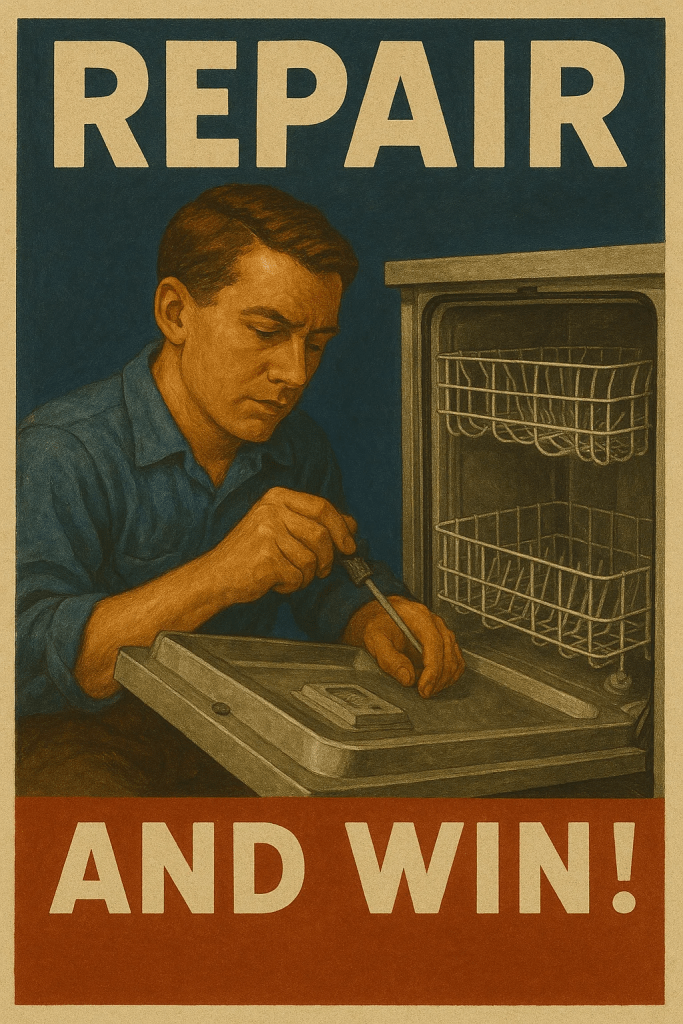
The “Fight to Repair” blog made a good point that with the disruption of the on/off imposition of tariffs is having on world trade is making more people see the importance of repair – https://fighttorepair.substack.com/p/the-world-is-at-war-on-trade-repair. If you either can’t get new products or they are more expensive then life extension through repair is becoming more important.
Kate
Been looking into possibility of running a Give/Take event, still keen to do it but struggling to find a suitable venue which is available during Great Big Green Week.
Planning Circularity at the Repair Cafe with books and magazines to give away or for people to exchange with their green books and magazines.
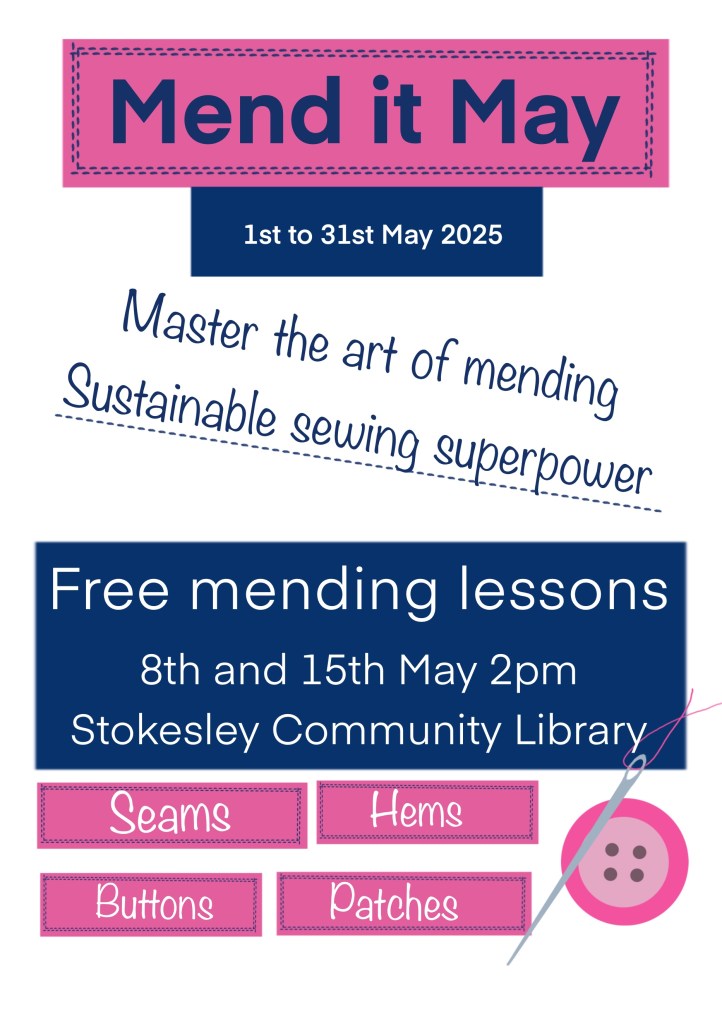
Two of our Repair Cafe’s Sewing Team, Jane Mercer and Jo Ackroyd, will be giving mending lessons in the Globe as part of Mend it May 8th and 15th May 2pm.
Matter Arising
Clothes Swap – Saturday 27th September 2025 – St Joseph’s Church Hall, Stokesley
Give or Take – looking for suitable venue and volunteers to help.
Repair Cafe:
– 15th March in Swainby was busy for Swainby with 86 items being brought in to be repaired.
Lots of successful repairs

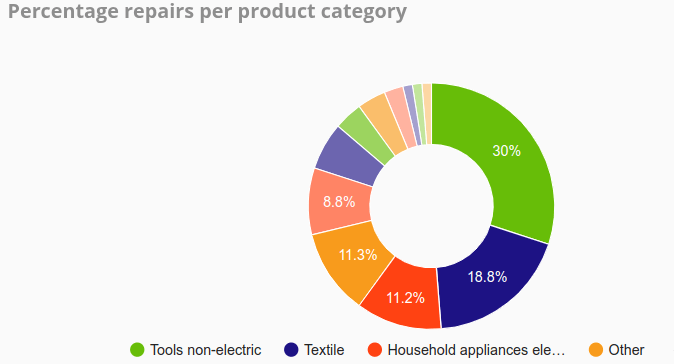
of lots of different things:

- 12th April Stokesley – Circularity
- 17th May Swainby
Northallerton Repair Cafe – 29th March Northdale – successful first cafe held – next cafe planned for 3rd May.
Meetings
Whole CASaV Group – Stokesley Globe 15th 7.30pm
River Tees Trust Talk – seagrass and oysters
AOB
Next Meeting
Tuesday 13th May 7pm – Please contact simongibbon@casav.uk for further details.
 Climate Action Stokesley and Villages