
Stop! Before you dig up those dandelions popping up in your lawn and garden, pause for a moment to think about how fascinating, useful and really rather beautiful these flowers are.
April 5th each year is designated Dandelion Day, to celebrate the enormous benefits – ecological, medicinal and edible – of this perennial plant many dismiss as a weed.
History & culture
The name dandelion comes from the French “dent de lion” meaning lion’s tooth. This refers to the leaves with their jagged tooth-like edges. In some cultures, dandelions are associated with hope and resilience, and blowing the seeds off a dandelion is a common wish-making tradition. Some believe the blown away seeds can carry thoughts and dreams to far away loved ones. In Celtic folklore, dandelions were seen as a potent symbol of the sun and were used in rituals around midsummer.
Edible & medicinal
Dandelions have been used as a food source and medicine for centuries across the world. They are hugely nutritious being rich in iron, calcium, magnesium, potassium and carotenoids as well as vitamins A, B, C, and D. The petals, leaves and roots are all edible – read on for recipes!
Dandelions have also been used medicinally to support liver function, aid digestion, promote healthy skin, and can act as a diuretic (with the French name “pissenlit” or “wet the bed” reflecting this use) although only in high concentrations.
Ecological
If all this weren’t enough reason to protect your dandelions rather than dig them up, their ecological role is even more essential. Dandelions play a vital ecological role by providing early spring nectar and pollen for more than fifty different species of insects including bees, moths, flies and wasps, many of which are essential pollinators. The insects which thrive on dandelions are an important food source for birds. Birds also feed on dandelion seeds later in the year. Having exceptionally deep roots means that dandelions loosen compacted soil, improve aeration, and make nutrients from deeper soil layers available to other plants. The flattened nature of their leaves provides shade to the soil, which can help retain moisture.
Recipes
Having made the wise decision to keep and even cultivate your dandelions you can then look forward to some exciting culinary treats (remembering to share your bounty with your garden wildlife)!
Dandelion Petal Honey
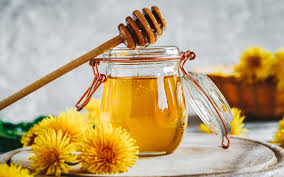
125g dandelion heads, stalks removed, 2 thin slices of lemon, 500ml water, 450g granulated sugar
1. Put dandelions and lemon slices in a saucepan and pour over the water. Put the saucepan on the hob over a low heat and allow to simmer for a 5-10 minutes, turn off the heat, cover the pan and leave to steep for a couple of hours.
2. Strain the liquid through a clean tea towel and squeeze to get every last drop of liquid. Measure the resulting (you should have about 450ml).
3. Put the liquid into a large saucepan (it will bubble up as it cooks so make sure you have plenty of space) and add the same amount of sugar (ie 450g sugar for 450ml of liquid).
4. Turn the heat onto medium-low and stir until all the sugar has dissolved. Then turn the heat to high & boil the mixture for about 10 minutes.
5. Test the honey frequently by taking a little bit on a spoon and putting it on a cold saucer, if it is thickening it is ready. It will still look liquid in the pan, but will thicken more as it cools.
6. Pot the mixture into a warm sterilised jar, while it is still hot. Because of the high sugar content, the dandelion honey will keep for at least 6 months but probably much longer.
Bees Knees Cocktail

Combine 60 ml gin, 25 ml fresh lemon juice, and 23 ml Dandelion Honey in an ice-filled shaker.
Shake until chilled, and strain into a coupe glass.
Wilted Dandelion Leaves with Garlic and Lemon
150g washed dandelion leaves, 1 finely chopped garlic clove, freshly squeezed lemon juice, salt and pepper, olive oil
1. Gently warm 2 tablespoons of olive oil in a saucepan.
2. Add the dandelions and wilt for about 2 minutes before adding the garlic.
3. Cook for a further 2 minutes. Season well with salt, pepper and a squeeze of lemon juice to taste.
Dandelion Root Cake

If you like Carrot Cake you’ll love this!
225g plain flour, 2 tsp baking powder, 1 tsp baking soda, 2 tsp cinnamon, ground, 1/2 tsp ground nutmeg, pinch ground cloves, ½ tsp salt
120ml runny honey, 180 ml vegetable oil, 3 large eggs beaten, 1 tsp vanilla extract, 500g peeled, grated dandelion roots
1. Mix the dry ingredients and then the wet ones in a separate bowl. Stir to combine, and then stir in the grated roots.
2. Pour the batter into a prepared cake / loaf tin & bake at 180 oC (160 oC fan oven) until firm.
3. Serve as it is or ice with a cream cheese frosting and decorate with dandelion petals.
CASaV Leaflets
This page is also available as one of a series of CASaV Leaflets, so you can download a printable pdf here – double sided tri-fold leaflet or an editable version which you can make your own and use for your group – OpenOffice document.
 Climate Action Stokesley and Villages